After MDevEng students visited Navajo Tech University for projects expanding NTU’s business and AI offerings, their NTU collaborators visited Berkeley to learn more about the university’s STEM and entrepreneurship activities.
After Conrad Begay finished his master’s degree in electrical engineering in December, the Navajo Technical University graduate went straight into teaching at his alma mater, with plans to pursue his PhD there.
Begay is also actively involved in leveling up NTU’s curriculum around the biggest topic in not just electrical engineering and computer science, but in all of academia: artificial intelligence. And to make AI a relevant and useful tool to the Navajo Nation.
So in July, Begay and three NTU students — Jonathan Smith (electrical engineering), Shannon Smith (business), and Marilane Descheny (business) — visited UC Berkeley to learn more about the university’s STEM and entrepreneurship activities after spending several weeks working with a trio of MDevEng students on projects expanding NTU’s business and AI offerings.
DevEng’s partnership with NTU goes back to 2022, when DevEng programs Director Yael Perez and NTU professor (and Begay’s advisor) Peter Romine presented a proposal for an engineering program centered on Indigenous sovereignty at an American Society for Engineering Education (ASEE) conference. (Perez also serves as program coordinator for the Native FEWS Alliance.)
Last summer, several MDevEng students visited NTU’s campus in Crownpoint, New Mexico to work with faculty and fellow students on a variety of engineering projects, ranging from solar energy to air quality monitoring.
This year, the NTU delegation’s tours of Berkeley’s labs, schools, and centers were an opportunity to see what lessons could be taken back to the tribal college for how to implement various STEM programs.
Along with Perez, the quartet learned about nuclear energy development for Indigenous peoples at the SALT lab, met with civil and environmental engineering Prof. Evan Variano, received advice from Prof. Eric Van Dusen about open-source AI education tools like Jupyter notebooks, and surveyed drones and quadrupeds used for social impact. The NTU students also received a crash course in Berkeley’s entrepreneurial ecosystem during a tour of Bakar Bio Labs, an incubator for life-sciences startups developing technologies to benefit society, by the Labs’ COO, Jeremy Alberga.
After a week on campus, they drove up to Ukiah to spend another week with the Pinoleville Pomo Nation, which culminated in the nation’s annual Big Time event.
Before their visit, however, MDevEng students were back at NTU, developing curricula and programs grounded in Diné (Navajo) values, community control over data, and social impact.
Shannon Smith collaborated with Sharon Wachira to create an AI micro-credential program guided, like the other projects, by Sa’ah Naaghái Bik’eh Hózhóón: “living in balance and harmony.”
Over 45 hours, the program’s students would study AI literacy and ethics before picking two of the following tracks: generative AI and productivity, data analysis and decision making, AI for community and professional practice, and AI innovation and community solutions. Every track includes material on ethics, data sovereignty, and tribal community connection.
Descheny teamed up with Kamilah Idris on developing NTU’s version of the Big Ideas Contest, Berkeley’s flagship student social entrepreneurship contest that is housed, like DevEng, at the Blum Center.
Contestants’ innovations across different topical tracks would be judged, in part, on community benefit: Does the project restore community balance rather than extract from it? They would go through the same stages as Berkeley Big Ideas teams: a pre-proposal, a full proposal, workshops, and a showcase with awards.
Like all NTU–MDevEng projects, the use of AI and data processing must respect privacy, prevent extraction, and maintain tribal control, Descheny and Idris said.
Though it was designed for NTU, it will be “completely replicable for every tribal college in the country,” Descheny added.
Chuol Ruei Deng (left) with Jonathan Smith at NTU.
Begay and Jonathan Smith, meanwhile, worked with Chuol Ruei Deng on designing a 16-week course on AI and Indigenous innovation that, like the other projects, bases its curriculum in four pillars of the Diné philosophy of education, Nitsáhákees, Nahat’á, Iiná, and Siih Hasin: “thinking, planning, living, and reflecting.”
“Indigenous innovation is not content added to an AI course,” they explained. “It is the lens through which AI is evaluated, questioned, and built.”
“The most rewarding part,” Deng said during his collaborators’ visit to the Bay Area, “was seeing how much more honest and specific AI education becomes when it is designed for a real place rather than a generic student population.”
Though he arrived at NTU knowing how to evaluate a machine learning model for bias, build a data pipeline, and source and verify research, “what I had not done before,” he added, “was figure out how to make all of that genuinely useful to a student who has never taken a computer science course but who lives next to an abandoned uranium mine, hauls water by truck, and belongs to a sovereign nation with its own legal infrastructure that predates AI entirely.”
Some two dozen students from around the world arrived at Berkeley last month to develop solutions to complex problems in under-resourced settings.
Amir Kelifa (Photo by Sam Goldman)
Amir Kelifa witnessed societal inequality in his home country of Ethiopia. He saw how workers in the informal sector, like waste collectors, faced exploitation, unsafe working conditions, and low pay.
Kelifa wants to change that.
He is among two dozen students who have just arrived at UC Berkeley for the Master of Development Engineering program planning to solve critical problems they see in the world.
“It’s very sad,” he said of the disparity between what waste collectors earn and the industries that benefit from the waste.
“Those who receive that waste and process it, exploit child and woman labor — they upcycle that waste and get more value out of it,” he said.
Kelifa wants to know more about these issues to figure out how to better integrate informal workers into the economy to provide people with “dignified work opportunities.”
“When I found Development Engineering and when I learned it combines all those things — engineering, economics, entrepreneurship and policy — to actually address such kinds of problems,” Kelifa said, “I was like yeah, this is my program.”
He has also seen the challenges entrepreneurs face in Ethiopia, especially youth and women who are often sidelined from starting businesses, he said.
“If you want to get your ideas off the ground and scale them, financing is a challenge,” he said. “There are no formal, well-established financing structures in place that can support you.”
To address this issue, he pointed to the need for financial technology in addition to an understanding of politics, social norms, and cultural nuances to create lasting solutions.
Kelifa is excited to learn from a diverse cohort and to be around the MDevEng program’s entrepreneurial culture.
The three-semester MDevEng program integrates engineering with entrepreneurship, design, public policy, and the social sciences to help students develop technological solutions in low-resourced communities.
Students in the Class of 2027 cohort came to Berkeley from countries all over the world, including the U.S., China, Bangladesh, Nepal, Rwanda, and beyond. They also have diverse professional backgrounds. While some have experience in mathematics, data science, and engineering, others have backgrounds in urban planning, economics, and even creative writing.
“The world is filled with many problems, and that means there’s lots of work for us to do together to find solutions to those big problems,” Daniel Fletcher, faculty director of the Blum Center, told them on their first day on campus. “It requires the backgrounds that you all have, the range of different backgrounds, and being able to communicate across those boundaries so that we can find solutions.”
Kara Nelson, chair of the Graduate Group in Development Engineering, reiterated the importance of working together to solve challenging issues. She pointed to the program’s emphasis on project-based learning and team work.
“The big problems that we face in the world cannot be solved by individual disciplines,” Nelson told students. “They are all interrelated to other sectors, and learning how to work in interdisciplinary teams is one of the things we focus on a lot in DevEng.”
Tanesha Aden, from Jakarta, Indonesia, has a background in urban planning and a former job working for the Indonesia government.
Tanesha Aden (Photo by Sam Goldman)
She wants to find solutions to problems that have been challenging to solve.
“Because Indonesia is still a developing country… by learning a lot of things in Development Engineering I can find more solutions to areas in Indonesia that are still underdeveloped,” she said.
One issue is the accessibility of public transportation. Aden saw this issue firsthand when she was pregnant and needed to take the bus from her home to work.
“I saw that some stations didn’t have elevators. I could still walk up stairs, but how about people with disabilities?” she asked.
Her classmate, Ben Fields, an industrial engineer, found the program after working with Engineers Without Borders, an organization that unites volunteer engineers and underserved communities to develop infrastructure solutions.
Ben Fields (Photo by Sam Goldman)
After working for a time in a corporate setting as an engineer, Fields realized he didn’t feel like he was helping anyone.
He wanted to do similar work to Engineers Without Borders. This led him to the MDevEng program.
“This graduate group seems more focused on how can we support the sphere of the world and everyone,” Fields said. “Not just our specific area, but using our area and our resources and our smarts and abilities to build up everyone.”
He looks forward to working on the connection between engineering, policy, and implementation, especially on issues with water and energy access.
The latter was a critical issue for a rural community in west North Carolina he worked with while an undergraduate at Clemson University.
He saw how hurricanes were hitting the town year after year. The community was located far from the coast, blocked by the Appalachian Mountains. Living at the end of the supply chain made getting access to resources to rebuild after the destruction a challenge, Fields said.
“If all the power lines go down and there are road blockages for 200 miles east of you, and there’s no way to access your town from the west,” he said, “you have to wait for all 200 of those miles to be repaired before it can actually do anything for you.”
When Michelle Gallaga moved to the U.S. from the Philippines with her two young kids in 2010, she didn’t know anyone in her new home.
“We had to start a life and really try to navigate being an immigrant and all the hardships that come with it,” she says.
“When you move to a different country at 40,” she adds, “people already have their own friends and their cliques, and so I never really got to form my own group of friends.”
Not having completed college, she found, limited her opportunities, and she encouraged her kids to pursue the degree she hadn’t attained. Once they had left home to do so, however, it didn’t sit quite right with her that she had pushed them to do something that she herself hadn’t been able to.
And so, as a birthday present to herself, Gallaga enrolled at Berkeley City College, and not without some apprehension.
But it wasn’t the first time that the graduating Global Poverty & Practice student had enrolled in college.
Gallaga had attended the University of the Philippines Conservatory of Music in Diliman as a voice major, while belonging to the Philippine Madrigal Singers, an a capella choir that took her around the world for festivals, world tours, and competitions.
She spent seven months away from the Philippines during the group’s 1989 tour and found it difficult to re-enroll in classes after returning, choosing to stay on with the choir for another three years.
She eventually did go back to school again, this time for music theory, but dropped out after joining a cover band.
In 2000, Gallaga got married, retired from singing, and gave college another shot, studying education to become an elementary school teacher. For two years she taught English in rural schools with poor infrastructure and limited educational resources.
“I loved the experience of being there and being around the enthusiasm of the children,” she said. “It was so fulfilling and so humbling. There was something about giving yourself to it that you get so much out of.”
But a divorce brought an end to the calling she had begun to develop, and she had to drop out again. Eventually, she moved to the U.S.
Now, years later in Berkeley, Gallaga was quickly discovering that she loved being back in the classroom.
With so much more life experience to apply to her lessons, the curriculum clicked in a way it hadn’t before. In 2023, she transferred to UC Berkeley to study sociology.
But making the most of her time at the country’s top public university was difficult while working two jobs: one providing translation and interpreting services for San Francisco government agencies, and another assisting a social entrepreneur pushing for equity in the psychedelics space. She could only attend class two days a week — not enough to build relationships or finally find community.
That is, until she met Valerie Moss, the Blum Center’s Assistant Director of Student Affairs, at a Global Poverty & Practice minor tabling session on campus. Examining and addressing poverty immediately struck a chord with Gallaga and harkened back to her experience teaching students in underserved schools.
Its lessons about understanding 20th-century development and 21st-century poverty alleviation left her feeling like “I was living a lie all my life,” she laughed.
This is it, she thought during that first semester in the minor. I want to learn more.
Her biggest lesson, she said, has come this current semester. She had arrived at GPP believing that the only way to make a difference in poverty alleviation was to do work that produced obvious, immediate results.
“Joining the minor was the smartest thing to do,” Gallaga said, “because GPP gave me the community that I needed to really feel like I belonged at UC Berkeley.”
For her practice experience, a core component of the program where students apply what they learn, Gallaga volunteered with Spiral Gardens, a small, nonprofit community garden providing fresh, nutritious produce in a historically redlined Berkeley neighborhood and food desert — a place she herself had lived in for 10 years.
Each Sunday, she would give tours of the garden to new volunteers, helped them get their own small garden projects off the ground, and mentored them. She grew food for her geographic community and gained the social community she had spent years looking for in the Bay Area and had begun to find in GPP.
Volunteering with Spiral Gardens also put into practice the lesson Prof. Kadir had imparted. Her biggest takeaway from GPP, Gallaga said, was “that I was there. I was a part of something. I did what I could, and I’ll keep doing what I can. And that’s enough. That’s what matters.”
After graduating this month, she plans to stay in the poverty-alleviation and nonprofit space. “Being able to keep working with organizations that help other people will always make me feel like I belong,” she said.
Her son graduated from UC Irvine in June, and her daughter will graduate from UC Santa Cruz next June.
“When I told my son, ‘I got into UC Berkeley!’ he was so jealous because he got rejected from Berkeley,” she recalled with a laugh. “But when I told him I got in, he said, ‘Mom’s the GOAT!’” — the greatest of all time.
And come December 20, when Gallaga crosses the stage to receive her diploma, they’ll be there to celebrate her degree.
She comes from a long line of tea farmers who cultivated the land long before global supply chains and corporate monopolies reshaped the region’s tea industry. Though she didn’t grow up on the farms full time, that history shaped how she understood land and labor.
Shreya Chaudhuri — an alumna of UC Berkeley’s Global Poverty and Practice (GPP) minor — was raised in the Bay Area, but she spent her summers thousands of miles away in eastern India, on her family’s tea farms in Assam.
She comes from a long line of tea farmers who cultivated the land long before global supply chains and corporate monopolies reshaped the region’s tea industry. Though she didn’t grow up on the farms full time, that history shaped how she understood land and labor.
Her mother carried that connection closer to home, spending time with Chaudhuri outdoors along the Bay Area’s beaches and among the redwood forests. Chaudhuri often tagged along while her mother gardened.
“I would mostly be talking,” Chaudhuri said, laughing. “But I was still with her outside.”
From those early experiences, Chaudhuri absorbed a philosophy that would shape her worldview and pull her towards environmental justice.
“Live in reciprocity with the land, respect the earth, and respect nature,” Chaudhuri said. “Never take more than you give.”
In middle school, Chaudhuri’s science teacher encouraged students to design their science fair projects around real-world problems, which stuck with her as she discovered her own interest in environmental science.
She found her footing during her senior year of high school, where her project on lead pollution in sub-Saharan Africa explored how algae could be used as a nature-based solution to remove heavy metals from water.
The project earned international recognition and was published with UNESCO, but more importantly, she said, it reframed her relationship to science — seeing it as a means of addressing inequality and environmental harm.
Chaudhuri doing field research in agroforestry (courtesy photo)
Her love for the environment would ultimately define her time at UC Berkeley, where she graduated in Spring 2025, received the Stronach Prize, and returned soon after to serve as a visiting scholar. Over the course of her education, Chaudhuri combined technical training in the sciences with political analysis, double majoring in environmental science and geography with an additional minor in data science.
The GPP minor program, however, is what Chaudhuri said truly “laid the foundation” for work with local communities in India.
The Global Poverty and Practice minor program, offered through the Blum Center of Developing Economies, challenges students to examine the structural roots of poverty and inequality while applying academic learning to community-engaged work.
Upon arriving at UC Berkeley, Chaudhuri planned to pursue a technical career in environmental microbiology. But after spending a summer working full time in a lab at the Carnegie Institution for Science her freshman year, she realized something was missing.
“There were already so many climate solutions,” she said. “But there wasn’t a bridge between the people who needed them the most and the people who were building them.”
Chaudhuri said that after taking several courses in the GPP minor, she was convinced the program could offer her something that no others at Berkeley could: coverage of perspectives from the Global South on climate change.
That focus shaped how Chaudhuri approached her GPP practice experience. Encouraged by GPP faculty to work with communities they were already part of, Chaudhuri centered the project on her own community in Assam. A defining element of the program, the practice experience is designed to help students bridge theoretical frameworks with real-world poverty action.
Chaudhuri with her parents and uncle at a Durga temple built by her great-grandfather on the tea farm in 1935 (courtesy photo)
She got the inspiration from a trip to India over two years ago, when she returned to her uncle’s tea farm and saw firsthand how farmers were reviving Indigenous agricultural practices — such as polyculture, mulching, and composting — in response to climate change and corporatization.
“It was incredible to see the on-the-ground work that’s happening in frontline communities,” Chaudhuri said. “I wanted to be able to go back into my community and help co-create something meaningful together.”
After learning more about her own family’s historic struggle with colonial rule over their farmland, Chaudhuri decided to document these Indigenous ecological methods while also examining colonial tea plantations in Assam and how colonialism has shaped the community’s ecology and geography.
That research expanded into her senior theses and, later, became the basis for the follow-up initiative — Equi-Tea: মাটিৰ মুক্তি, মানুহৰ মুক্তি (“liberation of the land is liberation of her people”) — that earned her the prestigious Judith Lee Stronach Baccalaureate Prize.
Through the prize, Chaudhuri is working with farmers today in Assam to build a direct-to-consumer tea brand rooted in those same Indigenous ecological principles. The model prioritizes organic cultivation and farmer-led decision-making, while cutting out corporate intermediaries that often absorb the bulk of profits. Even well-meaning brands limit farmer autonomy, she said, and don’t use the surplus profits to reinvest in the agrarian communities, who are struggling to transition to agroforestry. Chaudhuri’s brand aims to emphasize local economies, ecologies, and autonomies, while building bridges between the producers and consumers — something that the colonial supply chain sought to eradicate.
To tell their story, Chaudhuri is producing a short 30-minute film, drawing on interviews with farmers and footage from the fields. The goal, she said, is to show American audiences how tea farmers are struggling with climate change, colonial legacies, and global markets.
“They’re focused on daily survival and making sure that their tea farms last and exist; they don’t have the capacity to build out the storytelling and marketing models that a lot of brands in America do,” Chaudhuri said. “I want people to know what tea farms are going through because it is a microcosm of the climate crisis.”
She also brought this work back to UC Berkeley last summer through an interactive tea exhibition at the South and Southeast Asian Library in partnership with the Institute of South Asia Studies. While she worked as a Climate Action Fellow at the Student Environmental Resource Center, she created a campus café pop-up, where visitors could sample tea grown ethically using Indigenous methods.
Chaudhuri at a workshop on Indigenous burning traditions that she hosted with the Project Planet team at the International Science & Engineering Fair’s Education Outreach Day (courtesy photo)
Alongside her work on tea, Chaudhuri emphasized the importance of climate education, something she’s been actively pursuing since she was 16 when she founded Project Planet, a nonprofit dedicated to decolonial environmental education. On campus, this took shape as the Decolonizing Environmentalism DeCal she founded, as well as the Decolonial Environmental Network and American Cultures Environmental Justice Initiative.
Across all her experience, however, Chaudhuri stresses the importance of paying attention to how climate change is experienced on the frontlines, as well as to the Indigenous science, often overlooked in mainstream climate research, that communities already use to adapt to changing conditions.
“The majority of the people in this world are at the margins of the climate conversation, and we have to center their stories,” Chaudhuri said. “We have to center their narratives.”
Gallaga had attended the University of the Philippines Conservatory of Music in Diliman as a voice major, while belonging to the Philippine Madrigal Singers, an a capella choir that took her around the world for festivals, world tours, and competitions.
When Michelle Gallaga moved to the U.S. from the Philippines with her two young kids in 2010, she didn’t know anyone in her new home.
“We had to start a life and really try to navigate being an immigrant and all the hardships that come with it,” she says.
“When you move to a different country at 40,” she adds, “people already have their own friends and their cliques, and so I never really got to form my own group of friends.”
Not having completed college, she found, limited her opportunities, and she encouraged her kids to pursue the degree she hadn’t attained. Once they had left home to do so, however, it didn’t sit quite right with her that she had pushed them to do something that she herself hadn’t been able to.
And so, as a birthday present to herself, Gallaga enrolled at Berkeley City College, and not without some apprehension.
But it wasn’t the first time that the graduating Global Poverty & Practice student had enrolled in college.
Gallaga had attended the University of the Philippines Conservatory of Music in Diliman as a voice major, while belonging to the Philippine Madrigal Singers, an a capella choir that took her around the world for festivals, world tours, and competitions.
She spent seven months away from the Philippines during the group’s 1989 tour and found it difficult to re-enroll in classes after returning, choosing to stay on with the choir for another three years.
She eventually did go back to school again, this time for music theory, but dropped out after joining a cover band.
In 2000, Gallaga got married, retired from singing, and gave college another shot, studying education to become an elementary school teacher. For two years she taught English in rural schools with poor infrastructure and limited educational resources.
“I loved the experience of being there and being around the enthusiasm of the children,” she said. “It was so fulfilling and so humbling. There was something about giving yourself to it that you get so much out of.”
But a divorce brought an end to the calling she had begun to develop, and she had to drop out again. Eventually, she moved to the U.S.
Now, years later in Berkeley, Gallaga was quickly discovering that she loved being back in the classroom.
With so much more life experience to apply to her lessons, the curriculum clicked in a way it hadn’t before. In 2023, she transferred to UC Berkeley to study sociology.
But making the most of her time at the country’s top public university was difficult while working two jobs: one providing translation and interpreting services for San Francisco government agencies, and another assisting a social entrepreneur pushing for equity in the psychedelics space. She could only attend class two days a week — not enough to build relationships or finally find community.
That is, until she met Valerie Moss, the Blum Center’s Assistant Director of Student Affairs, at a Global Poverty & Practice minor tabling session on campus. Examining and addressing poverty immediately struck a chord with Gallaga and harkened back to her experience teaching students in underserved schools.
Its lessons about understanding 20th-century development and 21st-century poverty alleviation left her feeling like “I was living a lie all my life,” she laughed.
This is it, she thought during that first semester in the minor. I want to learn more.
Her biggest lesson, she said, has come this current semester. She had arrived at GPP believing that the only way to make a difference in poverty alleviation was to do work that produced obvious, immediate results.
“Joining the minor was the smartest thing to do,” Gallaga said, “because GPP gave me the community that I needed to really feel like I belonged at UC Berkeley.”
For her practice experience, a core component of the program where students apply what they learn, Gallaga volunteered with Spiral Gardens, a small, nonprofit community garden providing fresh, nutritious produce in a historically redlined Berkeley neighborhood and food desert — a place she herself had lived in for 10 years.
Gallaga at Spiral Gardens (courtesy photo)
Each Sunday, she would give tours of the garden to new volunteers, helped them get their own small garden projects off the ground, and mentored them. She grew food for her geographic community and gained the social community she had spent years looking for in the Bay Area and had begun to find in GPP.
Volunteering with Spiral Gardens also put into practice the lesson Prof. Kadir had imparted. Her biggest takeaway from GPP, Gallaga said, was “that I was there. I was a part of something. I did what I could, and I’ll keep doing what I can. And that’s enough. That’s what matters.”
After graduating this month, she plans to stay in the poverty-alleviation and nonprofit space. “Being able to keep working with organizations that help other people will always make me feel like I belong,” she said.
Her son graduated from UC Irvine in June, and her daughter will graduate from UC Santa Cruz next June.
“When I told my son, ‘I got into UC Berkeley!’ he was so jealous because he got rejected from Berkeley,” she recalled with a laugh. “But when I told him I got in, he said, ‘Mom’s the GOAT!’” — the greatest of all time.
And come December 20, when Gallaga crosses the stage to receive her diploma, they’ll be there to celebrate her degree.
With support from the Blum Center, the Berkeley Lab scientist and his colleagues provided the first substantive analysis of how electric lighting — specifically, high-efficiency solar-powered electric light sources unattached to an electrical grid — improves the lives and well-being of people using fuel-based lighting.
After attending a conference on electric lighting efficiency in New Delhi, India in 1995, Dr. Evan Mills stopped by Varanasi for a vacation.
One night, he wandered through a car-free warren of alleys lined with shopkeepers. Standing against a wall in the marketplace watching humanity flow by, he had an epiphany — one that
A merchant in Varanasi, India using a kerosene lantern during a night market. (Photo by Evan Mills)
would help pave the way for the adoption of off-grid solar lighting on a wide scale.
“I look down to my left, and there’s a man with a blanket spread out, three feet by three feet. He’s selling bracelets and beads, and he’s got a kerosene lamp that’s lighting his wares, and everything’s sparkling,” Mills, then a scientist at Lawrence Berkeley National Laboratory, recalled. “And that was the proverbial ah-ha moment.”
At first glance, such lamps have an enchanting aura to them. But after that conference, Mills couldn’t help but wonder how much fuel the vendor was using, how much carbon dioxide was being released, how many others out there relied on this dim source of light to practice their business, and whether viable alternatives could be developed and brought to market.
“And then I started this odyssey,” he said, “that went on for decades to really try to nail that down.”
With support from the Blum Center and several other funders, Mills and his colleagues addressed a gaping hole in lighting research. They provided the first substantive analysis of how electric lighting — specifically, high-efficiency solar-powered electric light sources unattached to an electrical grid — improves the lives and wellbeing of people using fuel-based lighting. He calls it “wireless lighting.” They went on to create and implement international standards for such products.
Dr. Evan Mills with kerosene lamps and early solar lanterns collected for testing (courtesy photo)
GOGLA, an international organization that later picked up the mantle of this work, has reached about 140 million people in the developing world by supporting dozens of companies and investors. Non-profit groups such as Light Up the World also did pioneering work on this problem.
Fuel-based lighting, on the other hand, like the Varanasi merchant’s kerosene lamp, is associated with various health, environmental, and economic problems.
Beyond the difficulty in doing basic activities under such dim and inefficient light sources, they are fire and burn hazards and can wreck indoor air quality. They are orders of magnitude more expensive than fluorescent or even “inefficient” incandescent lighting, per lumen (a unit of brightness).
“A homeowner [in the U.S.] spends maybe five percent of their income on energy,” including for their car, house, heating, cooling, refrigeration and more, Mills explained. “A very poor person can spend five percent of their income on kerosene lighting alone.”
Under the Lumina Project, Mills organized his studies of off-grid lighting solutions for low-income communities around the world, as well as the provision of information and analysis to consumers, industry, and policymakers.
“He just gifted it to the Blum Center and said, ‘Here, do something good with it,’” Mills said.
That good funded the Lumina Project and other activities at the Blum Center.
“We were very lean and mean,” Mills said, applying the Center’s funding to equipment purchases, travel to countries for research, and supporting Berkeley students getting involved in the project. “We made the resources go really far.”
A huge area of research Mills and his team were able to pursue was market characterization and needs assessments. On the technology side, white LED lights had just been commercialized, which meant that by packaging small rechargeable lithium or nickel-cadmium batteries and tiny solar panels, one could create portable and affordable solar lanterns at a fraction of the cost of bulky incumbent systems. Miniaturization and pre-purchase assembly of components stood to be major breakthroughs.
Users of fuel-based lighting are “not a monolith,” Mills said. “It’s not just a kid with a lantern doing their homework.” It’s also a doctor treating patients in a clinic, a schoolteacher in a windowless classroom trying to light their chalkboard, fisherpeople on a lake at night, chicken growers, nighttime security guards, people in cottage industries, and women moving around refugee camps. How did all these people use light? What did they pay for it? What were their nuts-and-bolts engineering needs?
A night market in Kisumu, Kenya (Photo by Evan Mills)
From Kenya to India, Tanzania to Bhutan, Mills and his Berkeley students would take prototypes of portable electric lighting sources — which don’t require special expertise to set up — into communities and be peppered with questions by prospective users already well versed in issues around lumens and durability.
When a community’s health clinics adopted off-grid solar lighting, postnatal maternal mortality decreased, as did infection rates. At kerosene-lit night markets, the diverse colors of goods like flip-flop sandals would wash out into the same hue; under LED headlamps, the colors became immediately distinguishable — along with enough light for vendors to count change under the table. Unlike candles and lanterns, solar lanterns would keep working in the wind and rain, and users weren’t vulnerable to fuel shortages or price spikes.
The funding from the Blum Center also allowed students to spend weeks in Kenya and Tanzania to join night fishing trips on Lake Victoria.
Some 100,000 people go out onto its waters each night, Mills said, with kerosene lanterns floating on little rafts to attract the fish’s food sources, which allows fishers to draw the fish into their nets. But half their income from one night’s catch would go toward kerosene for the next night’s trip, keeping the people impoverished.
Mills and his team built prototypes of LED lamps, and the students spent night after night weighing fish caught with the kerosene and electric lamps and comparing the costs associated with both kinds of catches. The electric lamps essentially doubled their income. They got the same results on Lake Tanganyika and at sea.
Fishers on Lake Victoria using an LED lamp developed by LBNL and UC Berkeley students (Photo by Tim Gengnagel)
They also dug deeper into the health effects of fuel-based lighting: not just the worse indoor air quality and the deadly fires that kerosene lanterns can cause, but synthesizing the literature from doctors treating young children who had been burned by these lamps or had accidentally consumed kerosene. They learned that people who suffered medical emergencies at night often had to wait until daylight to be seen at a clinic, exacerbating their illness or injury and causing longer clinic lines for everyone.
Mills also shed new light on the scale and effects of kerosene subsidies ($35 billion annually), the potential for job creation with electric lighting, and the resources the latter required. They estimated that 150,000 jobs in the world involved kerosene lighting, but the widespread adoption of off-grid solar lighting could potentially produce two million jobs. They also figured out the energy and resources it took to make their LED lanterns and how long those lanterns would have to be used to make up for what was put in. (Twenty to fifty days for a device that would last years.)
There was, however, one snake in the garden. More and more companies were producing affordable, turnkey off-grid solar lighting devices. Mills’ team tested many of them and found considerable variability in the quality of their light output, batteries, wiring, and more.
“Eventually the World Bank got a whiff of this,” Mills said — specifically its International Finance Corporation. Mills helped them develop a successful proposal to the Global Environmental Facility (GEF) to scale up a market-transformation effort.
Mills brought aboard Arne Jacobson of Cal Poly Humboldt’s Schatz Energy Research Center, who, while a PhD student in Cal’s Energy and Resources Group, had studied why older solar lighting systems — featuring big panels, long fluorescent tubes, and heavy car batteries that required an electrician and a year of income to buy — hadn’t been widely adopted. Virtually every obstacle could be overcome with the emerging compact LED systems.
Building on that work, the Berkeley Lab–Humboldt collaboration helped IFC develop test procedures and create a quality-assurance program. At the core was a product-certification program (today called VeraSol). Companies took to it quickly, Mills said, learning how to improve their products. And a warranty and truth-in-advertising component was essential to prevent market spoiling: users having a bad experience with a deficient product and giving up altogether on off-grid electrical lighting.
The momentum for off-grid lighting kept building. A regular conference, organized by IFC, attracted people from dozens of countries, including environmentalists, government officials, and investors. A vibrant, online social network was set up where folks around the world shared insights and innovations, troubleshooted issues together, and found community. As a sign of the gradual mainstreaming, television soap operas in Africa depicted people purchasing solar lanterns.
Eventually the United Nations took note.
The UN Environment Programme wanted to know the carbon-offset value of using a solar lantern, and commissioned Mills and his colleagues to develop a methodology the UNEP could use to evaluate the use of solar lanterns in carbon markets. Their methodology’s adoption came at a critical time given what had been learned about the variability in product performance and quality.
Despite all the success, Mills said, the World Bank and IFC did not intend to stick with off-grid lighting indefinitely, and the movement needed a new organization to continue carrying the torch.
Its proponents founded the Global Off-Grid Lighting Association, which shortened its name to GOGLA once it expanded to include compact and portable solar home kits that made solar energy services more affordable and useful beyond just lighting. GOGLA now assists the off-grid solar community with finance, consumer protection and standards, market insights, advocacy, policy, and more.
Mills, now retired from Berkeley Lab, has moved on to work on other problems. When he started this work, over a billion people lacked electricity. Some 140 million people across the developing world now benefit from the improved products, with about 7 million solar lanterns and multi-light kits and 1.6 million full solar home systems sold each year.
Berkeley students were essential to collecting the data that became the backbone of what the off-grid industry has become, Mills said. As was the Blum Center’s flexibility.
“Complex undertakings like this do take time, and they take patience and dedicated sponsors,” he said. “The Blum Center generously provided us with a lot of trust and latitude to be nimble and respond to new ideas and opportunities.”
“It was so exciting because it was such a green-field area,” Mills added. “There were other people who were poking at this, for sure. But we were right there at the beginning, and the Blum Center was right there on the ground floor with us.”
AgriSolar — a mobile and scalable solar-powered irrigation system designed for smallholder farmers’ accessibility and affordability — took home top honors and the first-ever Biggie trophy in the 12th annual Big Ideas Grand Prize Pitch Day on May 7.
AgriSolar — a mobile and scalable solar-powered irrigation system designed for smallholder farmers’ accessibility and affordability — took home top honors and the first-ever Biggie trophy in the 12th annual Big Ideas Grand Prize Pitch Day on May 7.
“It’s extremely exciting for the whole team that Big Ideas and others believe in this, believe in us, and are entrusting us with this award,” Raihan said. “This is a responsibility to do well.”
Read more about AgriSolar and this year’s Grand Prize Pitch Day here.
Yordanos Degu Zewdu’s journey to becoming a changemaker began as a child in Addis Ababa, inspired by a moment of compassion from her mother. At UC Berkeley’s Development Engineering graduation, she urged classmates to embrace resilience and unpredictability, fueling hope for a more just, equitable world.
Yordanos Degu Zewdu clearly remembers the moment she decided to become a changemaker helping those most in need: as a young kid in Addis Ababa, on the way home from shopping with her mother, right before the start of the school year.
Degu Zewdu and her mother came across a father and his two children. He appeared ill and was begging desperately for food for his hungry kids. The suffering and desperation moved the young Degu Zewdu deeply.
“But as a kid, I had no means to help. So I stood there, overwhelmed by a sense of helplessness,” she recalled. “My mother, the kindest person I’ve ever known, generously gave the father money to buy food for his kids, brightening their faces with joy.”
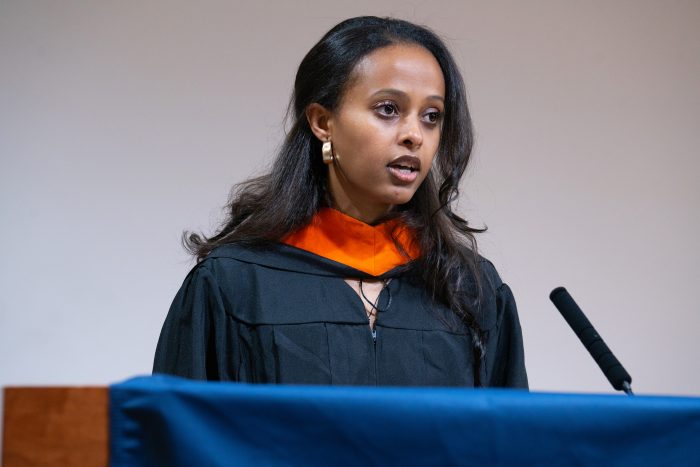
Yordanos Degu Zewdu (Photo by Amy Sullivan)
In that moment, she realized that “when I grew up, I wanted to be in a position to help communities and families in need.”
Degu Zewdu, who continues fulfilling that promise as a Development Engineer, recounted the story to her peers and their families last Friday evening at the commencement ceremony of the UC Berkeley Master of Development Engineering program’s Class of 2023 — the second-ever cohort of what is likely the world’s first such degree program. The group of 30, hailing from 13 countries, crossed the stage at Banatao Auditorium following three semesters, an internship, and a capstone project.
“We are here to celebrate the hard work you have put into this program and to honor your commitment, your courage, your tenacity, and your compassion,” said Prof. Kara Nelson, chair of the Graduate Group in Development Engineering. “And we thank you for the work that you are doing to make this world a more just place, a more equitable place, and more peaceful. You are an inspiration to all of us.”
The Class of 2023 worked on projects ranging from tracking and optimizing plastic waste collection for recycling in Uganda, to household sanitation and hygiene in Ethiopia, to policy needs as California transitions to greater renewable energy.
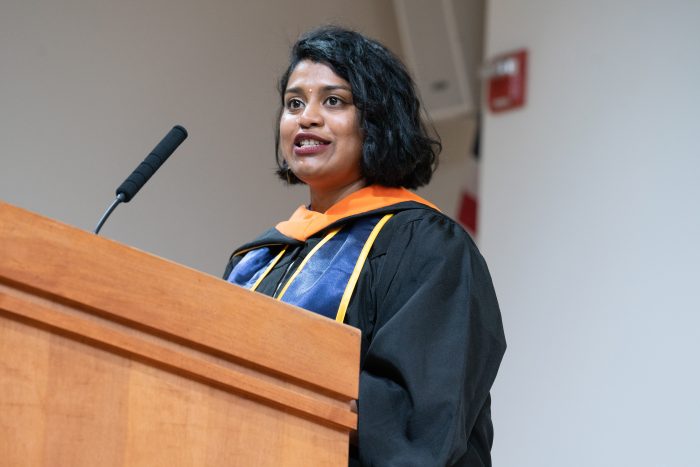
Despite impressive accomplishments in the classroom and out in the world, the variety and magnitude of the world’s problems can make DevEng work feel “like planting a singular seed in a vast desert and hoping for a forest to grow tomorrow,” said the evening’s other student speaker, Anjali Ravunniarath.
Anjali Ravunniarath (Photo by Amy Sullivan)
“I stand here, with the same big problems and no easy solutions. However, I have found solace in this community in the last year and a half,” she said. “Together, we’ve dissected a lot of systems, understood parts of it, and occasionally tried to see if we could fix a few. The problems may not have disappeared, but our collective efforts make it seem less daunting, and that’s truly what I’m grateful for.”
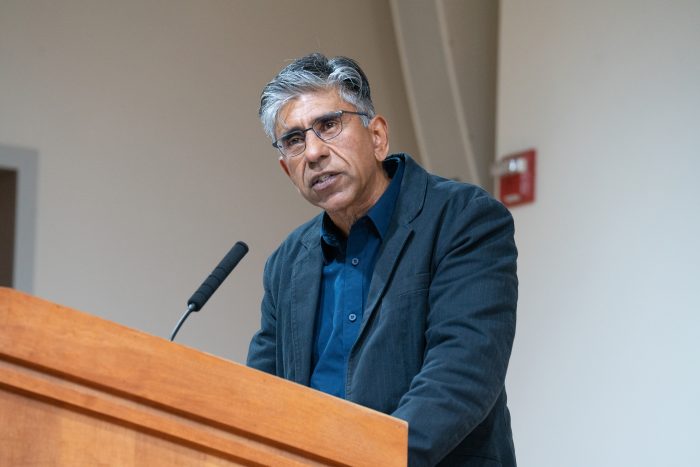
This constant change-making journey won’t always be smooth sailing, counseled the evening’s commencement speaker, Ranjiv Khush, a water scientist, member of Marin County’s water board, and co-founder of Aquaya, a nonprofit producing data and tools to support universal access to safe water, sanitation and hygiene. Even the most accomplished development engineers, like Prof. Amy Pickering, don’t get it right every time, he said.
“Here’s the thing: Amy and all of our other heroes, they make embarrassing professional mistakes. They mess things up. They feel ashamed,” he said. “Just like us.
Ranjiv Khush (Photo by Amy Sullivan)
“The difference,” Khush added, “is that they’re really good at rolling with it. They shake it off. They refuse to let their mistakes define them. Be the same: Shake it off. Please, do not let your mistakes and your embarrassments dissuade you from anything or get in the way of your success.”
Prof. Dan Fletcher closed out the ceremony with a challenge to the newly minted master’s-degree holders: “I want to challenge you each day after this program, as you move on with your careers, as you find your passions, as you live your passions, to be the best person that you imagined you could be while you were in this program.”
It was a sentiment with echoes of advice Degu Zewdu had offered earlier in the evening.
“As we set forth on our individual journeys,” she said, “I urge each of you to embrace life’s unpredictability, step out of your comfort zones, show resilience, remain open to the countless opportunities that await. It is in these moments of growth and uncertainty that we will unveil the authenticity of ourselves.”
DevEng Photo Contest Winners Highlight Both the Promise and Fragility of Technological Interventions
Development Engineering is a field of research and practice that combines the principles of engineering with economics, human-centered design, entrepreneurship, natural resources, and social science to create technological interventions in accordance with and for individuals living in low-resource settings. It’s a technical field, one often rendered in blueprints, lines of code, and physical devices.
But depicting DevEng to lay audiences is vital not just to raising the field’s academic profile but to growing the capacity of a discipline that tangibly improves lives as well as to highlight the richness and complexity of the communities DevEng aims to serve.
Each summer, students in UC Berkeley’s Master of Development Engineering program and the PhD designated emphasis in DevEng implement DevEng interventions close to home and far away, documenting their work and their environment as they go. This year’s DevEng Photography Contest highlights the best of this summer’s photos and videos, from the sometimes-precarious state of electrical power in rural places to novel technologies for delivering medicines and medical supplies. (Coincidentally, the three winners were captured in the same country.) Jacob Seigel Brielle and Isaac Seigel-Boettner, the talented Cal-alum duo behind Pedal Born Pictures, joined DevEng staff in judging this year’s submissions.
1st place
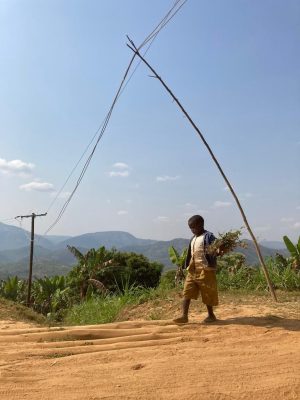
“The fragility of rural power”
Samuel Miles, PhD student, Energy & Resource Group; DevEng designated emphasis
“This is a picture of a young boy carrying out his chores in rural Rwanda,” says Miles. “The background shows rural infrastructure — in this case, a sagging power line held up by a local tree. It encapsulates the opportunities and challenges of modernity — the possibility that the boy grows up benefiting from electricity, but also the dangers poor planning represents to safety.”
Judges commended the great intersecting lines in the composition and how the photo’s symbolism deepens the more one dives into the image.
2nd place
“Zipline Drone Landing”
Rachel Dersch, Master of Development Engineering student
Dersch’s video depicts a medical delivery drone landing. The company behind it, Zipline, is a Silicon Valley start-up operating in various African countries, including Rwanda. “They make deliveries constantly to all the hospitals in Rwanda that contain blood, medicines, and supplies,” says Dersch. The company provides “quality employment” for their staff in Muhanga, Rwanda, she adds, and is being considered for her research team’s sites for solar power and water filtration units, since they require a landing pad for deliveries. “The drones are a really cool adaptation for developing countries when the road infrastructure makes time sensitive deliveries like blood difficult to accommodate,” Dersch says.
Judges appreciated the depiction of a fascinating new technology being used for good — and the importance in DevEng of testing tech first.
3rd place
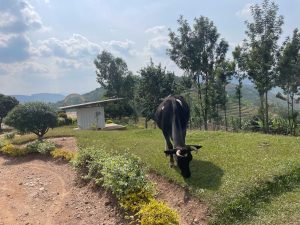
“Rural health clinic energy transitions in Rwanda”
Rachel Dersch, Master of Development Engineering student
“I like this photo because it showcases the complexity of working in rural locations where cows are grazing on hospital grounds next to new technology implementations,” Dersch says. “This photo was taken in a very remote location in the ‘Thousand Hills’ of Rwanda, a gorgeous place. We were at the location conducting qualitative interviews on the energy transition at the health clinic and picking up power monitoring sensors.”
Judges recognized this photo for the deeper story and symbolism behind it. Plus, “these sorts of juxtapositions help explain more of the why behind DevEng,” Seigel Brielle says.
Host and Fellow Responsibilities
Host Organizations
Identify staff supervisor to manage I&E Climate Action Fellow
Submit fellowship description and tasks
Engage in the matching process
Mentor and advise students
Communicate with Berkeley program director and give feedback on the program.
Berkeley Program Director
Communicate with host organizations, students, and other university departments to ensure smooth program operations
Student Fellows
Complete application and cohort activities
Communicate with staff and host organizations
Successfully complete assignments from host organization during summer practicum
Summarize and report summer experience activities post-fellowship